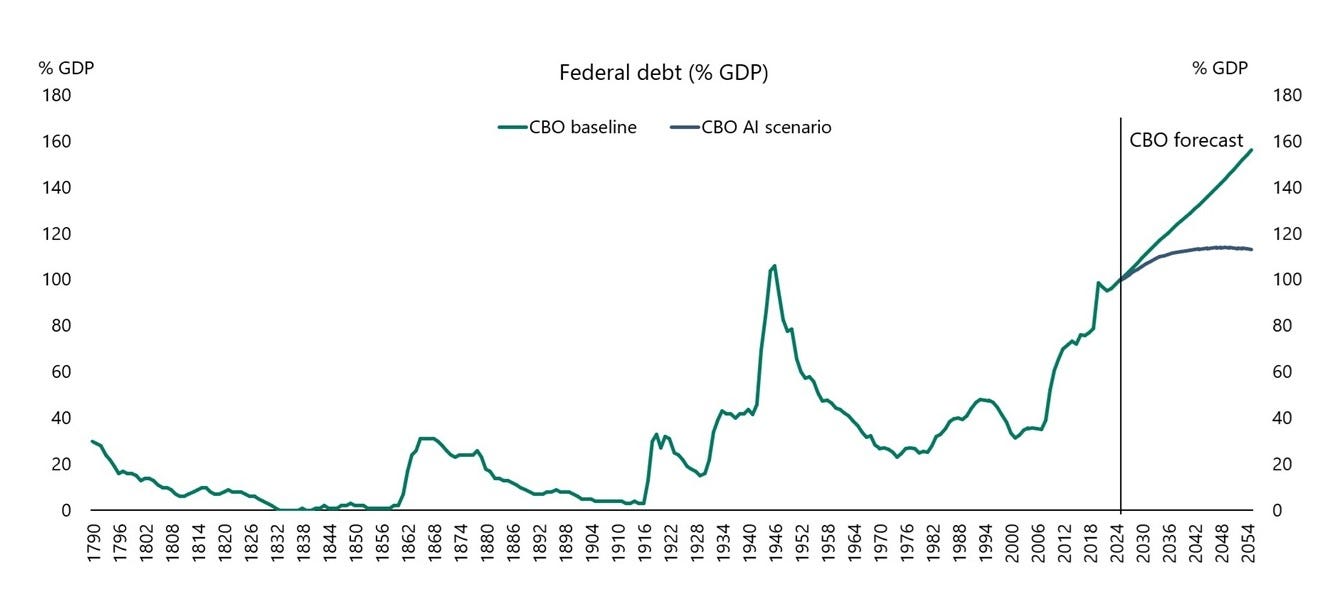
AI and U.S. Fiscal Debt

The below Congressional Budget Office chart depicts a scenario in which AI generates permanently higher GDP growth and permanently lower price inflation, thereby solving the U.S. debt problem. That scenario seems like wishful thinking.
First, CPI is woefully understated as we have previously written in these pages, due to the BLS’ use of substitution and hedonics in calculating CPI.
Second, we have a bigger problem than the $37 Trillion and counting Treasury debt outstanding, namely, Social Security, Medicare/Medicaid account for another $70 Trillion (approximate) in unfunded liabilities. So, the more accurate accounting of the fiscal debt is closer to $110 Trillion.
AI is powerful in all of its permutations, but not powerful enough to reverse the Dollar value erosion the U.S. has suffered as a result of its chronic deficit spending. Further, I do not believe AI will achieve its full automation / productivity potential until the U.S. economy operates on a Web3 standard as far as transactional documents and payments are concerned. Remove legacy process friction and AI will be better positioned to drive end-to-end automation.