

Anthropic and OpenAI are in a race to IPO first this year. Most every Software company is contemplating the impact of Gen AI on its business at the Board level. Anthropic is more top of mind given 80% of its Revenues are with Enterprises, whereas consumers are 75% of OpenAI Revenues. The podcast below is with Anthropic co-founder Dario Amodei, who has been making the media rounds since January. Here are several LLM-related news items:
OpenAI is about to make a splash on the agentic front when it announces its acquisition of OpenClaw, but that is more of a consumer play.
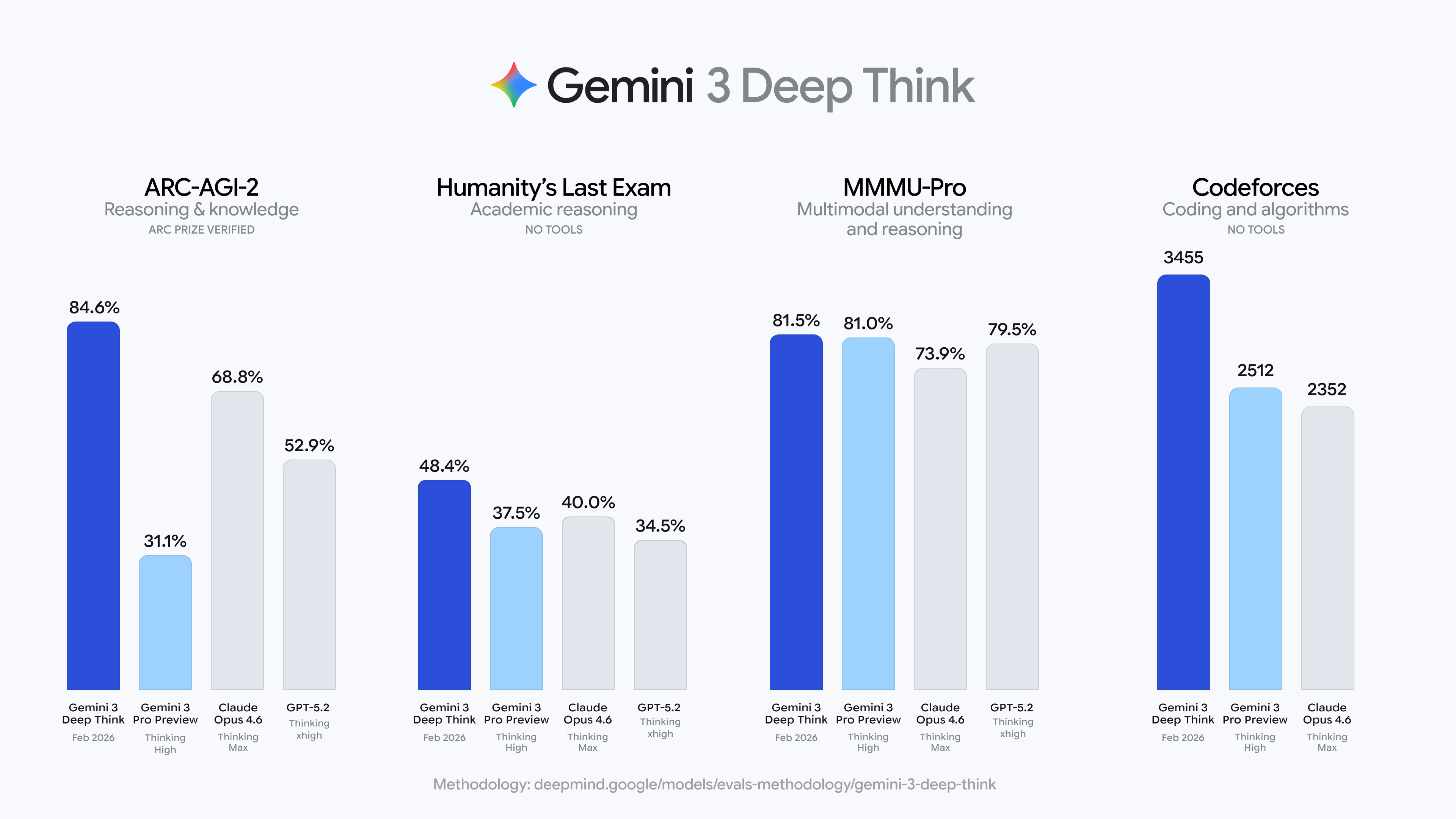
Google released Gemini Deep Think. I haven’t tried it as I do not want to pay for the bundle of stuff that comes with the model. Here is Deep Think on the evals (below), as per Google. I will test Deep Think when Google pushes out more broadly.
Claude Sonnet 5 is apparently to be released any day now. I have been using Opus 4.6 almost exclusively for coding.
This video features an in-depth conversation between host Dwarkesh Patel and Dario Amodei, the CEO of Anthropic. They discuss the trajectory of AI scaling, the timeline to AGI (often referred to as a “country of geniuses in a data center”), and the geopolitical and economic implications of such technology.
Summary of Key Topics
The “End of the Exponential” and Scaling
Amodei argues that the exponential growth in AI capabilities is proceeding largely as expected, moving from “smart high school student” to “PhD” levels. He believes we are nearing the end of this exponential curve, meaning we are close to achieving extremely powerful AI systems. He reiterates his “big blob of compute” hypothesis from 2017, suggesting that raw compute and data are the primary drivers of progress, rather than clever architectural tricks.
[00:18] Amodei notes that the “march of the models” is proceeding as expected, from high school to PhD level capabilities.
[02:02] He discusses his “big blob of compute” hypothesis, stating that scaling compute and data matters more than specific algorithmic cleverness.
Timelines: “Country of Geniuses” in 1-3 Years
Amodei predicts that we will reach a level of AI capability equivalent to a “country of geniuses in a data center” likely within 1 to 3 years (roughly 2026 or 2027). He assigns a ~90% probability to this happening within 10 years, with the remaining uncertainty due to physical disasters or severe societal disruptions.
[14:00] Amodei gives a 90% confidence level that we will see a “country of geniuses in a data center” within 10 years.
[45:44] He refines his hunch to a timeframe of 1 to 3 years from now.
Economic Diffusion vs. Technical Progress
A major theme is the distinction between the speed of technical progress (which is blistering) and economic diffusion (which takes time). Even if we have AGI in 2026, it will take time to cure diseases or reorganize the economy due to regulatory and physical constraints. However, he expects this diffusion to happen much faster than in previous technological revolutions.
[23:13] He explains that while model capabilities are on a fast exponential curve, economic diffusion faces friction (e.g., “change management,” legal reviews), making it fast but not instant.
[49:10] Using the example of curing diseases, he notes that even with an AI that can invent cures, clinical trials and manufacturing still take time.
AI in Software Engineering
They discuss the impact of AI on coding. Amodei views this as a spectrum: currently, AI writes a high percentage of lines of code, but the goal is to have AI handle 90-100% of software engineering tasks (e.g., setting up clusters, writing memos).
[18:05] Amodei lays out a spectrum for AI coding, moving from writing lines of code to executing full end-to-end engineering tasks.
The Economics of AI Labs & Compute
Amodei explains why AI labs might not show traditional profits yet. The industry requires massive upfront capital expenditure for compute to train future models. A company could be operationally profitable on its current models but show a loss due to the immense cost of training the next generation of models to stay competitive.
[51:21] He discusses the risks of buying trillions of dollars in compute too early, noting that being off by even a year in demand predictions can lead to bankruptcy.
[01:09:39] Explanation of how a company can have high gross margins on inference but still lose money overall due to the exponential cost of training new models.
Geopolitics and Authoritarianism
Amodei expresses deep concern about authoritarian regimes acquiring powerful AI. He fears that AI could make totalitarianism more durable by automating surveillance and control. He advocates for a “coalition of democracies” to set the rules of the road before such regimes can dominate.
[01:33:27] Discussion on the need for an architecture of governance to manage the proliferation of powerful AI systems.
[01:49:03] Amodei worries that AI could enable governments to oppress their populations more effectively, potentially creating “high-tech authoritarian states” that are hard to displace.
Regulation: State vs. Federal
They touch on recent state-level regulations, such as a Tennessee bill banning “emotional” AI. Amodei generally opposes a patchwork of state laws and prefers federal regulation, but argues against a federal moratorium on state laws if the federal government isn’t going to act on safety risks itself.
[01:36:28] Amodei criticizes the Tennessee bill specifically but argues that a federal ban on state regulation without a federal plan is dangerous.
Anthropic’s Culture
Amodei describes his role as CEO of a 2,500-person company, emphasizing the importance of culture. He conducts “Dario Vision Quests” (internal talks/memos) to maintain transparency and trust within the company.
[02:19:22] He describes his internal “Dario Vision Quest” sessions where he speaks candidly to the company every two weeks to align everyone on the mission and strategy.
Relevant Links:
[00:00] Video Start
[13:00] Discussion on AGI timelines
[23:00] Economic diffusion of AI
[01:31:00] Geopolitics and Authoritarianism