"Debt Does Not Matter" They Say. In Fact, Debt Matters.


Investors often repeat the refrain “debt does not matter”. In fact, debt matters.
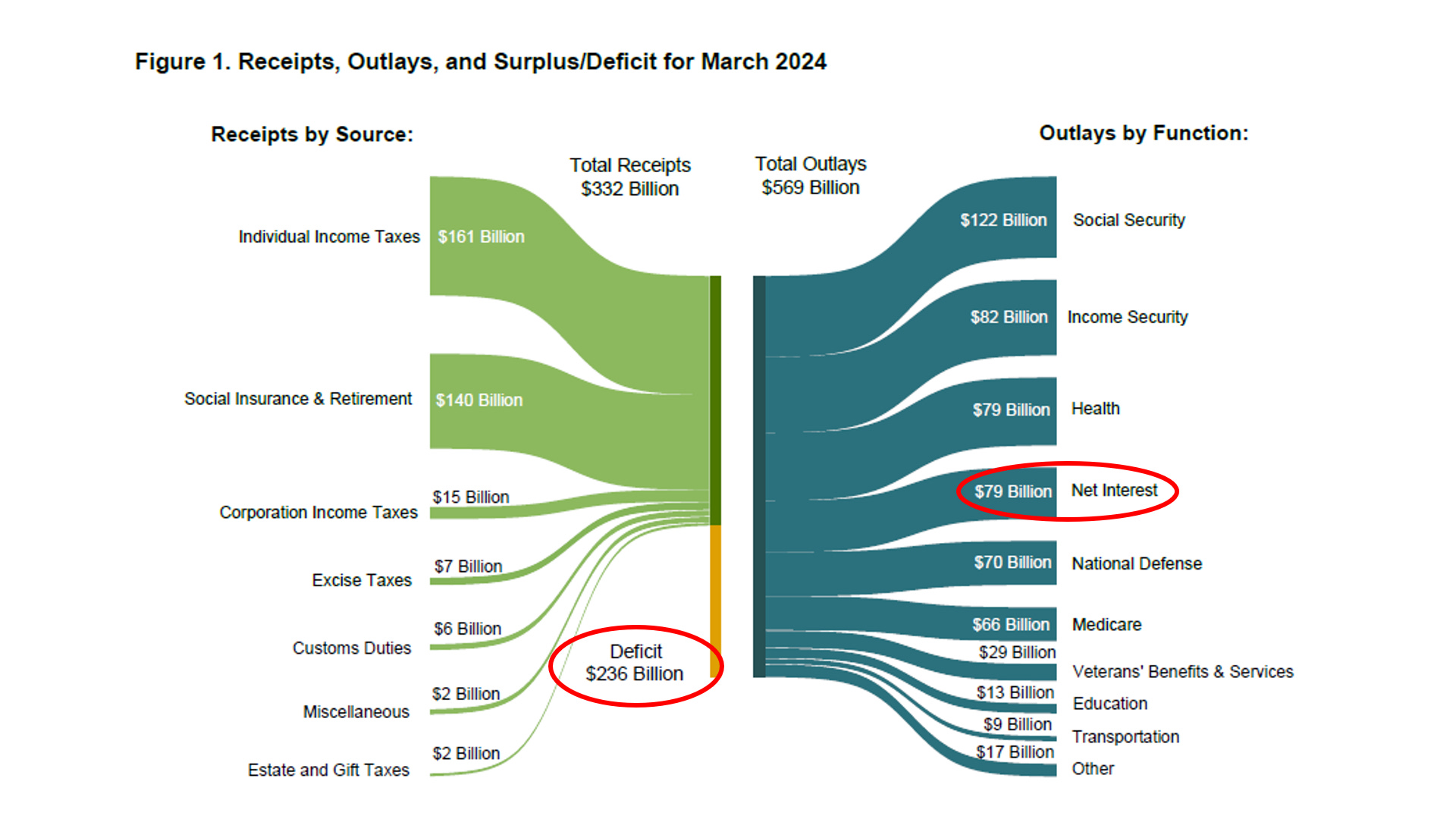
The Federal Government ran a $236 Billion deficit in the month of March. That is an annualized rate of $2.8 Trillion.
The Federal Government plugs deficits by issuing debt. If Treasury were to issue $2.8 Trillion in new debt at fiscal year-end, I can promise you the market would not absorb the entire $2.8 Trillion. The Federal Reserve would be required to step in and purchase what did not sell at auction.
The moment the Fed spends one Dollar, it increases the money supply (M1) by one Dollar and therefore dilutes the existing money supply by one Dollar – thereby devaluing the Dollar’s purchasing power (i.e. inflation). Therefore, debt matters, as it inevitably results in a weaker Dollar and higher prices.
However, we are not done as to why debt matters. There is the matter of the Federal Government having to service the existing debt ($34.6 Trillion). The Federal Government spent $79 Billion on Net Interest in the month of March ($948 Billion annualized). Interest Expense was the third largest Federal expense category in March (tied with Health, $79 Billion), behind only Social Security ($122 Billion) and Income Security ($82 Billion) and ahead of National Defense ($70 Billion). The irony is that Interest Expense is in fact contributing to the Fiscal Deficit.
There is also the matter of maturing Treasury debt – i.e. the principal. Not only does the Government not have the capital to pay down the Interest Expense, it does not have the capital to pay the principal when Treasury debt matures. This means that Treasury issues new debt, the proceeds of which go to paying down principal and interest.
Talk about a vicious cycle.