Fiscal Stimulus Provided Liquidity in 2023

Fiscal stimulus-related “income security” programs born during the COVID crisis provided liquidity that helped absorb the Fed’s tightening during fiscal 2023 (year-ended September 30th).
Year-to-date, fiscal spending is up 17% year-over-year, although it is too early to tell what the annual run rate may be as it relates to “income security” programs. We expect income security-related spending to ramp-up as November’s general election approaches. You may drill down on “income security” program spending HERE.
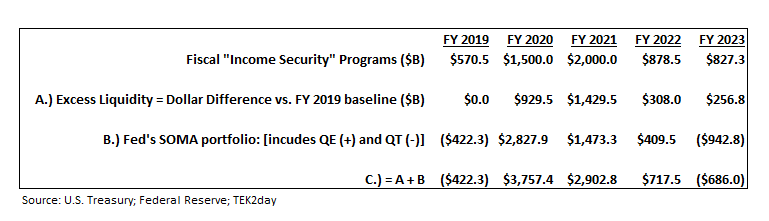
Income security spending ranged from $535-571 billion per year from fiscal 2017 – fiscal 2019. We used fiscal 2019’s $571 billion figure as a baseline figure given that fiscal 2019 was the last year prior to COVID-related stimulus spending.
Line item “A” shows the incremental “income security” spending in that year over 2019’s baseline level. Think of this as incremental liquidity added to the economy.
Line item “B” shows the Fed’s holdings in Treasury and Govt. Agency securities. A negative number means the Fed removed liquidity from the system. A positive number means the Fed added liquidity.
Line item “C” shows that while the Fed pulled $943 billion of liquidity from the system (these figures do not contemplate the impact of Fed Funds rate changes), there was an incremental $257 billion of income security spending that mitigated the Fed’s tightening.