

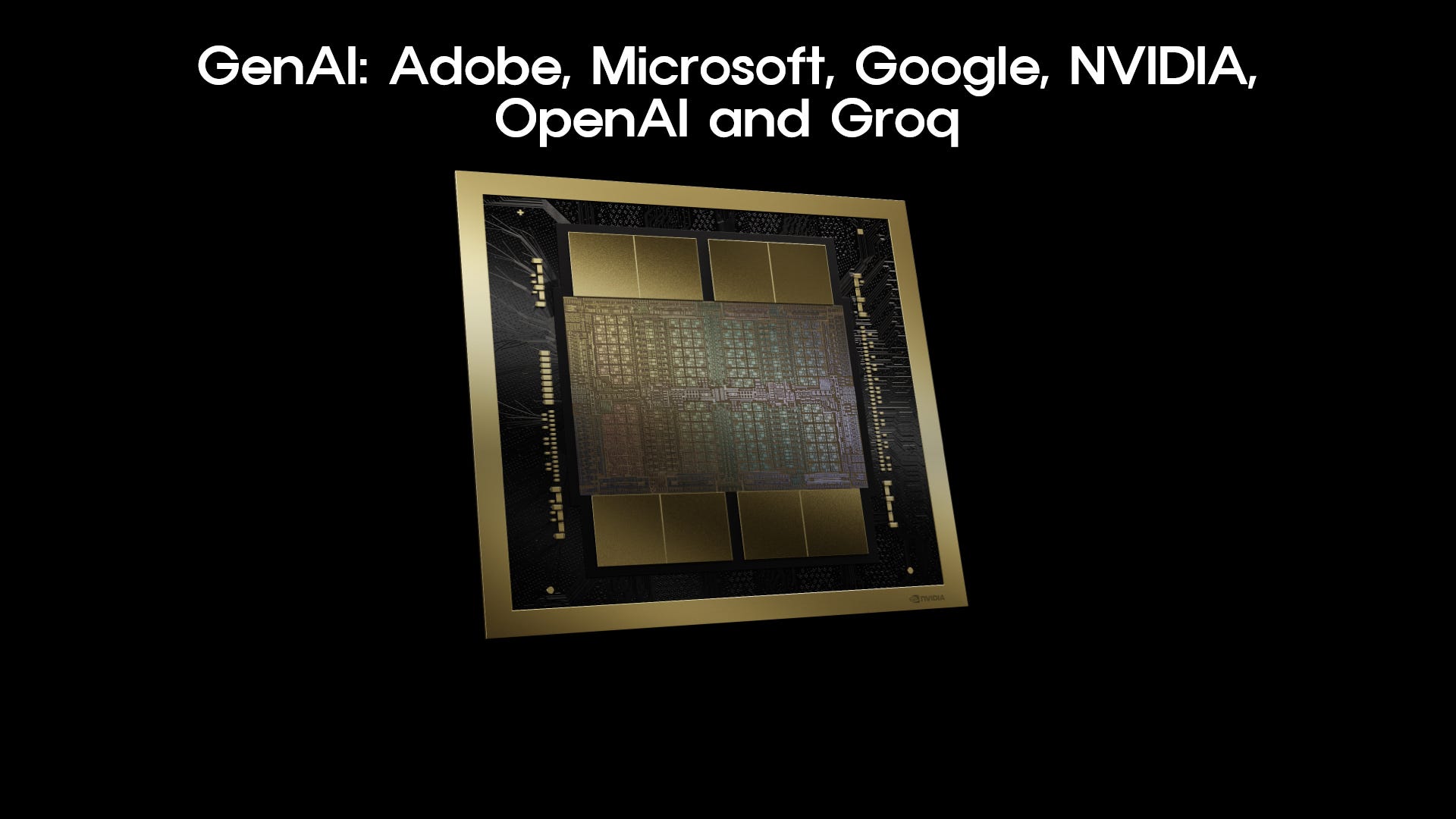
Adobe’s product releases. Today’s Adobe (ADBE) GenAI product releases are built on top of Microsoft Azure’s GenAI capability, which is powered by OpenAI’s GenAI LLMs, which are powered by NVIDIA’s chips.
GenAI Revenue. Today, GenAI revenue primarily accrues to the chip designer (NVIDIA, Google, Groq to name several) and to the LLM builder (OpenAI, Google, Mistral to name several).
Chip designer Groq. I agree with Groq, OpenAI and others that there is greater value and a greater revenue opportunity on the inference side of LLMs versus the model training / data labeling side. The chip/software configuration that generates the fastest, highest quality inference outcomes will win the market. However, when I run the same query on Groq (Groq chips and opensource LLMs) and ChatGPT (NVIDIA chips and OpenAI’s LLMs), ChatGPT yields faster results than Groq, which runs counter to Groq’s side-by-side Groq vs. ChatGPT demo that recently went viral. See for yourself by running a query experiment at Groq.com and ChatGPT.
Groq’s recent voice demo - what do you think? I am not sure that I fully believe the authenticity of Groq’s recent voice AI demo performed by Groq founder Jonathan Ross on February 28th in Qatar. I feel as though the speed with which the voice AI responded was far quicker than Groq’s response to text-based queries. How could voice response be so nimble when the text response is sluggish? The opposite ought to be true. See Groq’s voice demo below with founder Jonathan Ross. The demo portion is approximately the first 10 minutes of the video. Let me know what you think.