The title says it all. No acquirer wants to pay a rich multiple to get a deal done. This is especially true when the macro environment softens because that softening creeps into sales pipelines which makes acquirers assign more risk to target company sales pipelines. More risk means downward valuation adjustments.
You may be surprised at how quickly soft macro data impacts sales cycles. Customer company CFOs and CEOs tend to hold off on making sizable investments in products and services when negative macro news is released as has been the case for the past number of weeks. This means sales cycles get pushed out indefinitely.
Companies that run quality M&A programs know this and adjust for it. They will calibrate deal terms to reflect the fact that they have less confidence in the target company’s sales pipeline.
What that valuation adjustment may look like depends upon a number of variables including the stage of the deal, the deal structure (upfront purchase consideration versus earnout), the total purchase consideration and to what degree the acquirer truly values the target company’s management team, products, services and customers (these are a few key factors).
Reward future performance. As an acquiring company, you never want the upfront multiple to be a figure that you are not comfortable with. Be willing to pay a fair multiple for past performance, but the real upside to the target company’s valuation ought to be a function of future performance. If the target company’s management team significantly beats Revenue and EBITDA targets over an agreed upon period, that management team ought to be rewarded for that outperformance.
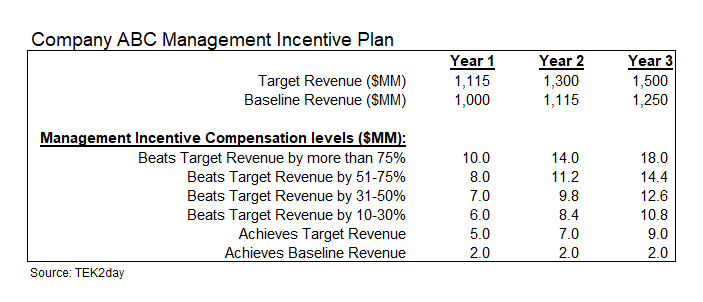
Use incentive compensation packages to drive future performance. Management’s incentive compensation package should reflect different levels for achieving various Revenue and EBITDA thresholds. These thresholds should be agreed upon pre-close (the acquirer ought to drive this process obviously). Those thresholds should be dumped into a spreadsheet and may look something like the following (the below covers future Revenue but not future EBITDA performance):