Interest Rates Will Come Down Before The Federal Government Cuts Spending

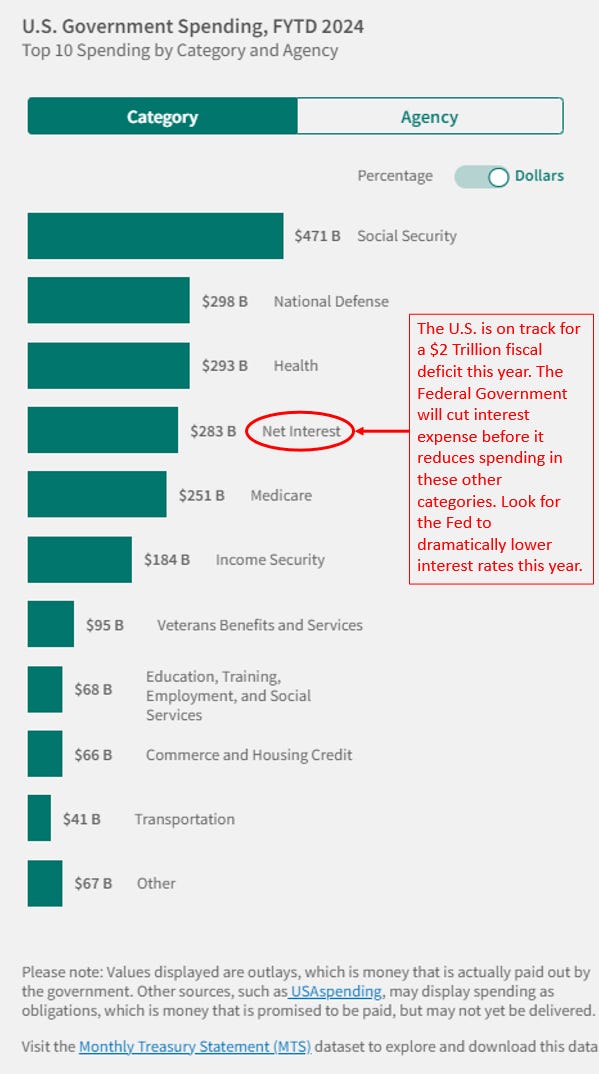
There is no way on God’s green earth that the Federal Government will cut spending. The U.S. is on pace for a $2 Trillion fiscal deficit this year which will drive Treasury Debt outstanding to $36.5-37.0 Trillion. That is one reality. The second reality is that the current fiscal spending level is unsustainable. So, where will the Federal Government reduce expenses?
The Federal Government won’t cut Social Security spending (yet) nor Medicare (yet), income security (yet) or spending on socialized Healthcare or Housing. It won’t cut the National Defense budget or any other Government initiative. However, it will seek to reduce the interest expense burden on the Treasury debt. That interest expense burden will be approximately $1 Trillion in fiscal 2024. How will the Federal Government reduce the interest expense burden? One can’t simply reduce interest expense with the snap of a finger.
In order to reduce interest expense on the $34.4 Trillion of Treasury debt outstanding, one must either shrink the Treasury debt (that is not happening) or reduce the interest rate. The interest rate will be reduced. Fed Chair Jerome Powell will face immense pressure to reduce interest rates given the enormous debt burden that the U.S. faces. I suspect that within the next 12 months the Fed will dramatically reduce its fed funds rate to around 1%. The U.S. can’t afford 2-5% rates on short-term or intermediate-term Treasury paper, the interest expense burden is simply too great.
The Fed will be back buying Treasuries in a big way by November when Yellen’s Treasury will auction some $2 Trillion of Treasury securities to plug the fiscal deficit. I don’t see China or Japan as a big Treasury buyer. The Fed will be the big buyer. Good old left pocket, right pocket fiscal and monetary policy. This can only mean one thing - while the Dollar may hang in there versus other currencies, the Dollar will continue to lose value versus the price of various products, services and physical commodities, including gold.