
Meta Seems To Have Already Lost The Generative AI Arms Race

ChatGPT 3 had 175 billion parameters, GPT 4 is estimated to have 17.5 Trillion parameters and the yet to be released GPT 5 may have approximately 175 Trillion parameters. That is quite a head start.
GPT has become the “Intel inside” (that phrase used to mean something) for application software companies that wish to imbue their applications with Generative AI capability.
GPT’s LLMs learn as people use the ChatGPT app and as companies utilize GPT’s APIs (in addition to the LLMs crawling public and maybe not so public data).
Google is chasing GPT with its Gemini series of LLMs (Gemini model parameters have not been disclosed, although I would guess Gemini is operating at GPT 3’s level). Gemini LLMs can leverage Google’s AI knowledge repository and AI-infused product portfolio.
Google Gemini or ChatGPT may benefit from deployment on iPhones, which will further lend data that may be used to train underlying LLM models.
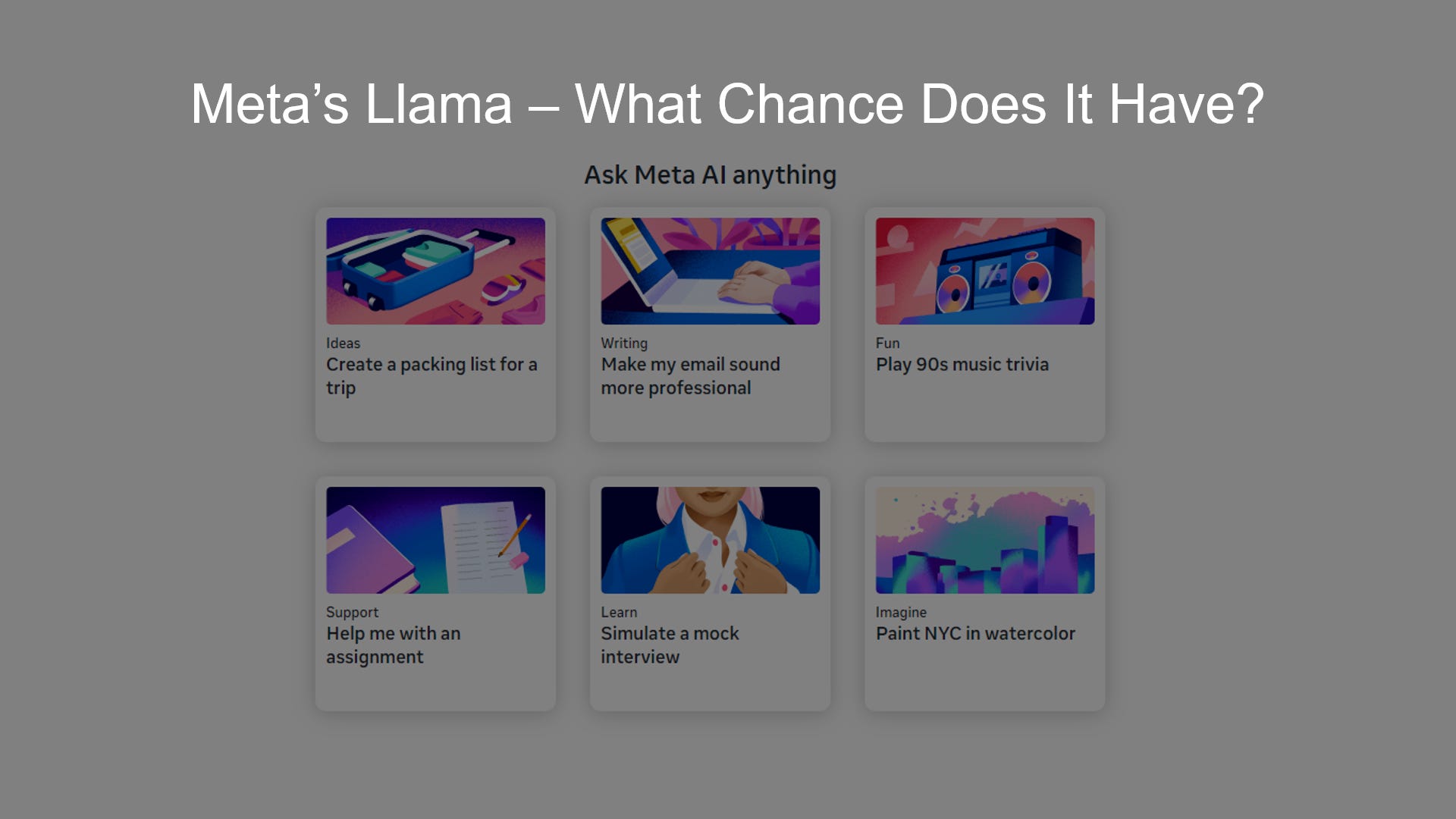
Where does this leave Meta with its open source approach to Generative AI? How will Meta’s Llama models ever catch OpenAI’s GPT offering or Google’s Gemini offering? I suppose that Meta could train its Llama models in part with Facebook, Instagram and Messenger data, which would give Llama an edge (and create privacy issues), although Meta does not cite those sources as germane to Llama’s training process.
I feel as though Meta has already lost the Generative AI arms race - which at the end of the day is only a two-horse race between OpenAI and Google (three horses if you include China).
Learn more about Llama HERE and HERE.