

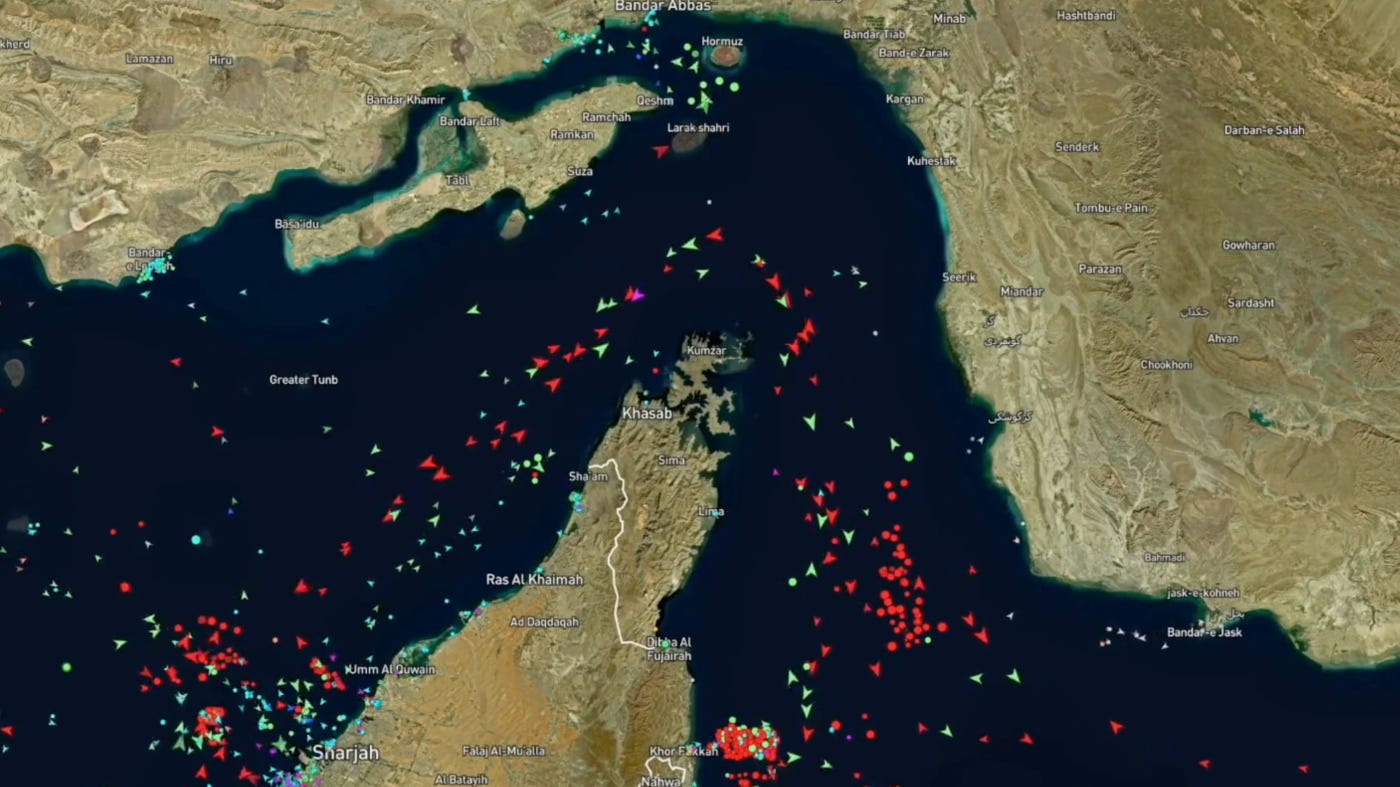
If I’m Iran I would plan to maintain control of the Strait of Hormuz indefinitely as a safeguard against Israel and the U.S. no matter the rhetoric, at least for the rest of 2026.
As a result the Fed will ease and long-term rates will fall temporarily before Treasury investors do the math and decide they want more than a 4% yield as the credit quality of the underlying issuer weakens.
Here’s Kilby’s take:
prompt: How would a smart U.S. negotiator work to re-open the Strait of Hormuz?
Kilby: This is a live, active crisis — so let me give you a real answer grounded in what’s actually happening right now, not a textbook exercise.
The Situation as of Today (April 9, 2026)
The U.S. and Iran agreed to a two-week ceasefire on April 7 after nearly six weeks of fighting. But Iran closed the strait again only a few hours after it briefly reopened on April 8, following Israeli strikes on Lebanon.
Further negotiations are set for April 10 in Islamabad. Iran has confirmed participation; the U.S. has indicated it is considering in-person talks but hasn’t confirmed a delegation.
The core problem: the military campaign degraded Iran’s hardware but didn’t resolve its strategic leverage. Iran has proven it can deny transit at an acceptable cost to itself — and no plausible U.S. military option can reliably reverse that in the near term.
What a Smart U.S. Negotiator Would Actually Do
1. Resolve the Israel-Lebanon trigger first.
The strait keeps closing because of Israeli strikes on Lebanon, not because of the core U.S.-Iran deal. Iran’s IRGC said shipping stopped following Israeli strikes in Lebanon, which it considered a ceasefire violation. A smart negotiator gets Israel to pause operations in Lebanon for the duration of the talks — otherwise every Israeli airstrike hands Iran a pretext to re-close the strait. JD Vance has already acknowledged Israel may need to “check themselves a little bit.”
2. Don’t concede the legal framework.
Iran is pushing for formal authority to regulate and toll strait traffic — essentially the Montreux Convention model Turkey has over the Turkish Straits. Opening the strait requires a negotiated outcome that preserves the legal regime of transit passage without conceding to Iran’s attempt to rewrite it.
Allowing Iran and Oman to start charging tolls would set a dangerous precedent.
A smart negotiator signals absolute firmness here — not because of ideology, but because conceding it would blow up U.S. credibility with every ally who has a chokepoint near their adversary.
3. Use China and India as back-channel pressure — not just coalition partners.
Several countries have already struck bilateral deals with Iran to let their vessels pass — Pakistan, India, Thailand, Russia, Turkey, China, Iraq, and Malaysia. That’s actually useful. China gets a third of its oil through the strait. A smart negotiator privately tells Beijing: “You want this open permanently — help us. Your bilateral deal with Iran doesn’t solve the structural problem.” China has more economic leverage over Iran than the U.S. does right now. Use it.
4. Offer Iran something real on sanctions — with a clear mechanism and reversibility.
Trump noted the U.S. is “talking tariff and sanctions relief.” That’s the right currency. Iran needs reconstruction funds — Iran’s 10-point proposal includes allowing it and Oman to charge tolls, with the money earmarked for reconstruction. The smart move is to offer a credible, phased sanctions relief package tied directly to verified reopening and sustained free transit — structured so it auto-reverses if Iran closes the strait again. Give them the economic win without giving them the legal win.
5. Internationalize the security guarantee so the U.S. isn’t the sole enforcer.
Britain organized 40 foreign ministers to discuss ways to reopen the strait, and options like reflagging tankers and convoy operations — used successfully in the 1988 Tanker Wars — should be on the table.
A smart U.S. negotiator builds a multilateral escort framework so any future Iranian closure is an act against 40 nations, not just the U.S. That changes Iran’s cost-benefit calculation durably.
6. Separate the nuclear file from the strait — at least for now.
Iran has not agreed to stop building ballistic missiles or arming proxy forces, and has not abandoned nuclear weapons development — all of which Trump laid out as goals. Trying to solve all of that in the same negotiation as strait reopening creates a hostage dynamic where Iran can block everything by stonewalling on nukes. A smart negotiator sequences: strait open first, verified, then nuclear talks. Don’t let the harder problem poison the solvable one.
Bottom Line
The military campaign created leverage but not resolution. “The dilemma of the Strait of Hormuz has no military solution,” as Iranian analysts have noted — and frankly they’re right about that piece. The path to a durable reopening runs through Beijing, a phased sanctions-relief offer that gives Iran economic oxygen without legitimizing its legal claims, Israeli restraint in Lebanon as a condition of any deal, and a multilateral security framework that makes future closures costlier than staying open.
The Islamabad talks Saturday are the real test. Watch whether the U.S. sends a principal-level delegation — that alone will signal how serious Washington is about a negotiated resolution versus a strategic stall.